
Have you ever placed a bet and felt completely lost when trying to understand what the odds actually meant? You’re not alone. Many sports bettors jump into the game without truly grasping the fundamentals of betting odds, which is like trying to build a house without a blueprint. Understanding betting odds is not just some optional extra; it’s the bedrock upon which all successful and profitable betting strategies are built.
This expert guide is designed to take you from novice to knowledgeable, transforming the way you see and interact with sports betting. You’ll learn to decipher different types of odds, calculate potential payouts, assess value, and ultimately, make smarter, more informed betting decisions. By the end of this article, you will understand how to navigate the world of betting odds, unlocking the potential for increased profits and a more enjoyable betting experience.
Decoding the Three Primary Odds Formats
Understanding the different ways betting odds are presented—American, Decimal, and Fractional—is the foundational step in navigating the world of wagering. Each format offers a unique perspective on the probability of an event and potential payouts.
American Odds: Plus and Minus Signs Explained
American odds, also known as moneyline odds, use plus (+) and minus (-) signs to indicate the favorite and underdog. A minus sign (-) indicates the amount you need to bet to win $100, while a plus sign (+) shows the amount you could win for every $100 wagered.
Decimal Odds: Simple and Straightforward
Decimal odds represent the total payout you’ll receive for every $1 wagered, including the return of your stake. To calculate potential winnings, simply multiply your stake by the decimal odds. For example, Decimal odds express the return on investment as a decimal figure. To calculate your potential winnings, simply multiply your stake by the decimal odd. This format is super easy to read and understand.
Fractional Odds: A Traditional Approach
Fractional odds, commonly used in the UK, express the ratio of the amount won to the stake. For example, odds of 5/1 mean you win $5 for every $1 wagered, in addition to getting your original stake back. To calculate the total payout, multiply your stake by the numerator (the first number) and then add your stake back in. This type of odds is a little bit messy because the calculation is not simple.
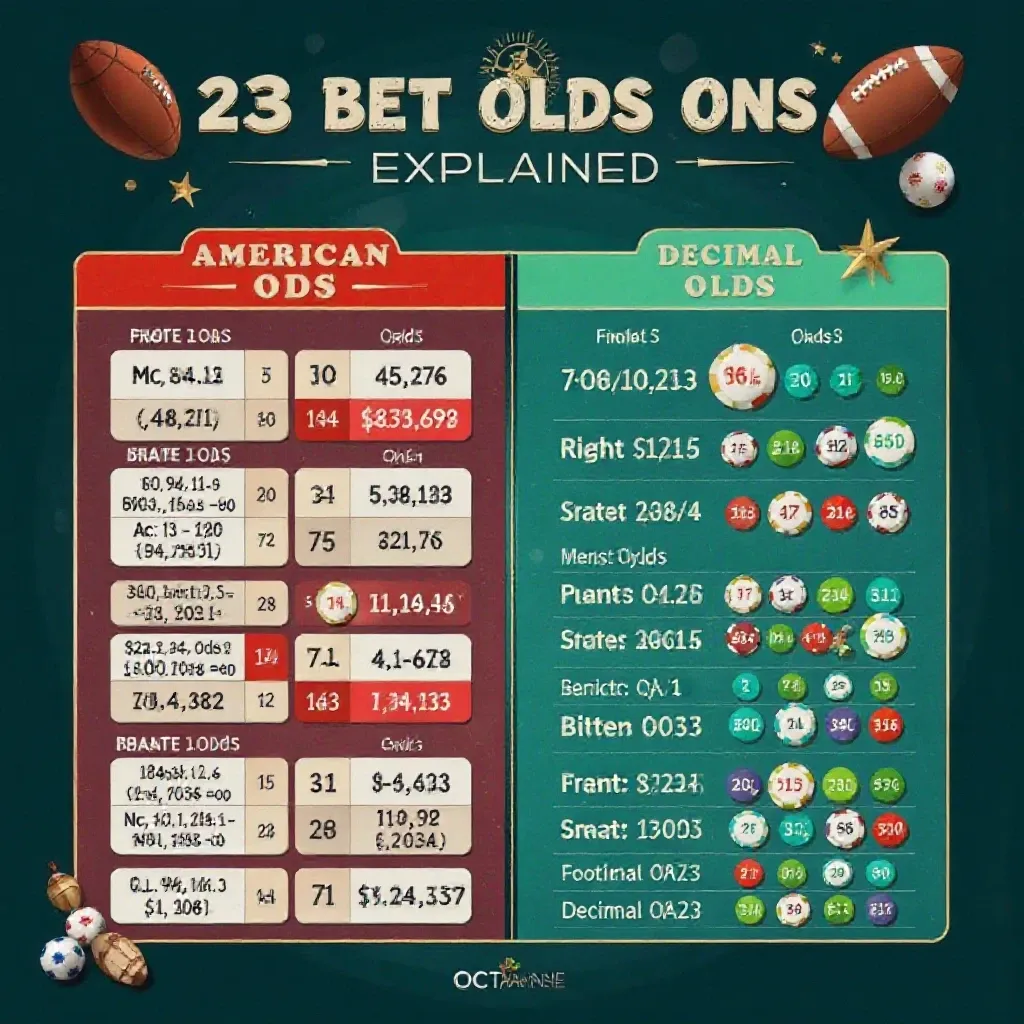
Converting Between Odds Formats: A Practical Guide
Understanding odds is crucial for successful sports betting. However, different sportsbooks often display odds in various formats: American, Decimal, and Fractional. Knowing how to convert between these formats allows you to easily compare odds across different platforms and identify the most lucrative betting opportunities. This, in turn, maximizes your potential winnings and ensures you’re always getting the best possible price.
American to Decimal: Easy Steps
Converting American odds to Decimal odds involves a simple formula. If the American odds are positive (e.g., +200), divide them by 100 and add 1. So, Decimal odds = (American odds / 100) + 1. For example, +200 in American odds becomes (200/100) + 1 = 3.00 in Decimal odds. If the American odds are negative (e.g., -150), divide 100 by the absolute value of the American odds and then add 1. Decimals odds = (100 / |American odds|) + 1. Meaning -150 in American odds turns into (100/150) + 1 = 1.67 in Decimal odds.
Decimal to Fractional: Using the Tools
Converting from Decimal to Fractional odds requires a bit more work, but tools can simplify the process. First, subtract 1 from the decimal odds. For example, a Decimal odd of 3.00 becomes 2.00 after subtracting 1. Convert the remaining decimal into a fraction. Then, simplify the fraction to its lowest terms. Charts and online converters are available to quickly find the fractional equivalent, otherwise, you can use long division. For example, an odd of 1.67 after subtracting 1 became 0.67. It would become 67/100.
Fractional to American: The other way
To convert Fractional odds to American odds, you’ll use different formulas depending on whether the implied probability is greater or less than 50%. If the fractional odds are less than 1 (e.g. 1/2), then the formula can be: American odds = – (fraction 100). For example: 1/2. -(0.5*100) = -50 American odds. However, if the fractional odds are greater than 1 (e.g. 2/1), then the formula can be: American odds = fraction 100. Using the same example: Fractional odds of 2/1. Applying the formula: 2 100 = +200 American odds.
Understanding Implied Probability: Seeing Beyond the Numbers
Implied probability is a crucial tool for anyone interested in making informed decisions based on odds. It allows you to translate odds, which can sometimes feel abstract, into a percentage chance of an event occurring. This is essential for assessing the true likelihood of an outcome and identifying potential value bets – situations where the odds offered are more favorable than your own assessment of the event’s probability.
Essentially, implied probability represents what the odds-makers believe is the chance of something happening. However, the real power comes from comparing that implied probability to your own analysis. If you think an event is more likely than the implied probability suggests, you might have found a valuable betting opportunity. This is at the heart of value betting and maximizing your expected value over the long run. By calculating your own probability and comparing that to the implied probability, you can identify opportunities that bring great value.
American Implied Probability Formula
American odds can be a bit confusing, but calculating the implied probability is straightforward. If the American odds are positive, the formula is: 100 / (Odds + 100). For example, if the odds are +200, the implied probability is 100 / (200 + 100) = 100 / 300 = 0.333, or 33.3%. If the American odds are negative, the formula is: Odds / (Odds + 100). For example, if the odds are -150, the implied probability is 150 / (150 + 100) = 150 / 250 = 0.60, or 60%. Understanding this conversion is key to assessing value.
Fractional Implied Probability Math
Fractional odds, commonly used in the UK, are expressed as a ratio (e.g., 2/1). To calculate the implied probability, the formula is: Denominator / (Denominator + Numerator). For example, if the odds are 3/1, the implied probability is 1 / (1 + 3) = 1 / 4 = 0.25, or 25%. Another example, if the odds are 6/4, the implied probability is 4 / (4 + 6) = 4 / 10 = 0.4, or 40%. The lower the fraction, the higher the chance to win.
Decimal Implied Probability Made Easy
Decimal odds are popular in Europe and Australia. The implied probability calculation is the simplest of the three: 1 / Decimal Odds. For instance, if the decimal odds are 2.0, the implied probability is 1 / 2.0 = 0.5, or 50%. If the decimal odds are 1.5, the implied probability is 1 / 1.5 = 0.666, or 66.6%. It’s a direct and easy way to see the percentage chance priced into the odds, making comparisons to your own estimation simple.
The Vig: How Sportsbooks Make Their Money
Understanding the ‘vig,’ also known as ‘juice,’ is crucial to becoming a savvy sports bettor. It’s how sportsbooks ensure profitability, and ignoring it means you’re likely getting bad value on your bets. The vig is essentially a commission built into the odds, representing the sportsbook’s cut. This betting margin is how they make money regardless of the game’s outcome. It’s embedded directly within the odds they offer, subtly affecting your potential payout.
To calculate the vig, you can use a simple formula considering all possible outcomes. For a two-outcome bet (like a moneyline bet), the formula looks something like this, implied probability of outcome A + implied probability of outcome B – 1. For example, if one team is at +110 and the other is at -110, this is how you will calculate: (100/(110+100))+(110/(100+110))-1 = 4.76%
The higher the vig, the more the sportsbook profits, and the less you potentially win. That’s why smart bettors ‘shop for lines’ – comparing odds across different sportsbooks to find the lowest possible vig. Over time, minimizing the vig can significantly increase your winnings and decrease your losses.
What’s the Vig for Real?
Ever heard of someone placing what they thought was an easy win, only to realize they barely broke even, or even lost money? That’s the vig at work. Imagine someone betting on a heavy favorite, seeing odds that appear almost guaranteed. They throw down a large sum, confident of a return. But after the win and payout, they realize the profit is shockingly small. This real-life mistake highlights the crucial need to pay attention to the vig.
Looking for the lowers Vigs
Finding the lowest vig requires a bit of effort but is well worth it. Many tools are available to simplify the process, including vig calculators. Understanding how odds are presented (decimal, fractional, etc.) is also crucial. Converting between these formats, especially when comparing across different sportsbooks, is essential. Decimal odds are easiest to work with for vig calculation, but fractional odds are the industry standard. Don’t be lazy and learn easy ways to convert it.
Finding Value: Identifying Profitable Betting Opportunities
Value betting is about finding situations where your assessment of a probability is more accurate than the implied probability reflected in the bookmaker’s odds. It’s not about guaranteed wins; it’s about consistently making bets where the potential return outweighs the inherent risk. Essentially, you are looking for discrepancies between what you believe is likely to happen and what the odds suggest.
To identify value bets, thorough research and analysis are essential. Start by understanding the factors that influence the outcome of a match or event. Consider team form, player statistics, historical data, and any other relevant information. Once you have a good understanding of the landscape, you can begin to form your own opinions on the probabilities involved.
Compare your assessment of the probabilities with the odds offered by different bookmakers. Look for situations where your calculated probability of an event occurring is higher than the implied probability suggested by the odds. This difference represents potential value. Remember, even if a value bet loses, consistently making these bets over time will increase your chances of long-term profitability.
Know your sport will
There once was a fervent sports enthusiast, eager to augment his passion with profit through betting. He stumbled upon a so-called “sports analyst” promising surefire wins. Blinded by the allure of easy money, he invested heavily, only to witness his bets crumble one after another. The “analyst’s” predictions proved baseless, turning his dreams of wealth into a harsh lesson: Trusting blindly can lead to significant financial losses, highlighting the importance of independent research and a healthy dose of skepticism.
Using data in your favor
Transforming raw sports data into winning betting strategies doesn’t require complex algorithms. Start with basics: track team performance over time using simple charts to identify trends. For example, visualize a team’s scoring record at home versus away games. Look for discrepancies between the odds and the data; if your analysis suggests a higher probability of an event than the odds imply, you might have found a value bet. Remember, even basic data analysis can significantly sharpen your betting acumen and lead to more profitable decisions.
Advanced Strategies: Level Up Your Betting Game
Once you’ve mastered the fundamentals of sports betting, it’s time to explore strategies that can give you a real edge. Arbitrage betting, hedging, and understanding market sentiment are some of the advanced techniques that separate casual bettors from those who consistently profit. However, be warned: these strategies require significant knowledge, discipline, and a willingness to accept potential risks.
Arbitrage betting, also known as “sure betting,” involves placing bets on all possible outcomes of an event across different bookmakers. The goal is to exploit discrepancies in odds offered by various bookmakers to guarantee a profit, regardless of the outcome. For example, if one bookmaker offers odds of 2.10 on Team A winning a match, and another offers odds of 2.10 on Team B winning, you could bet on both teams and secure a small profit. This strategy requires quick reflexes and access to multiple betting accounts. Warning: Arbitrage opportunities are rare and often short-lived. Bookmakers may also limit or close accounts suspected of arbitrage betting.
Hedging is another risk management technique where you place a bet on the opposite outcome of your original bet to reduce potential losses or secure a profit. For example, if you placed a futures bet on a team to win the championship at the start of the season, and they make it to the finals, you could hedge your bet by wagering on their opponent. This guarantees a profit regardless of who wins the championship. Warning: Hedging reduces potential profits and requires careful calculation to ensure it’s beneficial.
Understanding market sentiment involves assessing the overall attitude of bettors and the public towards a particular event. This can be gauged by monitoring news, social media, and betting trends. If a large number of people are betting on a particular outcome, the odds may shift, creating opportunities to capitalize on perceived value. However, remember that market sentiment isn’t always accurate and can be influenced by hype or misinformation. Warning: Relying solely on market sentiment can be risky. Backtest your theories before implementing in real life. Always combine it with your own research and analysis.
What’s the Vig for Real?
A market analyst once overlooked the vig, advocating for a seemingly advantageous underdog pick. Fueled by public sentiment, the bet gained traction, yet the analyst’s failure to account for the bookmaker’s commission resulted in a slight loss, underscoring the critical nature of factoring in what really counts.
Using the odds in your favor
Navigating odds becomes easier with conversion charts. Decimal odds (e.g., 2.0) represent the total payout per dollar wagered, while Fractional odds (e.g., 1/1) show the profit relative to the stake. Convert between them to identify the most favorable offers across different platforms. Using tools to make this happen should be your goal in easy betting.
Conclusion
Navigating the world of betting odds can feel like deciphering a complex code, but with a clear understanding, it transforms into a powerful tool. We’ve journeyed through the intricacies of different odds formats—decimal, fractional, and American—unveiling how each one translates into implied probability and potential payouts. Remember, grasping these nuances is not just about knowing how to read the numbers; it’s about understanding the value they represent.
The ability to calculate potential winnings, compare odds across various platforms, and assess the implied probability of an outcome empowers you to make smarter, more strategic bets. Ultimately, the goal is to approach sports betting with knowledge and discipline, turning potential risks into calculated opportunities. Embrace this expert advice, apply these strategies, and elevate your betting game for potentially more profitable outcomes.